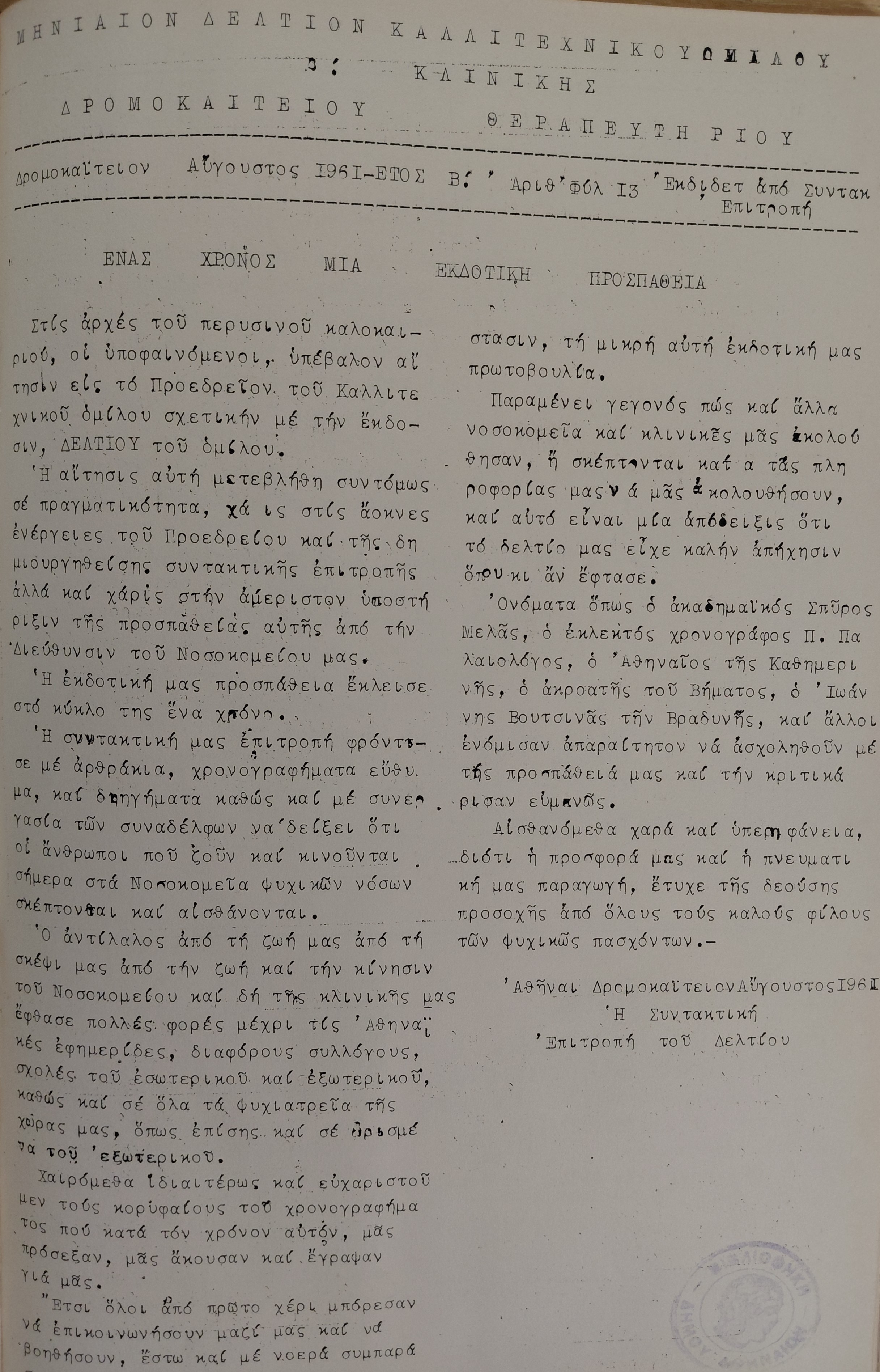
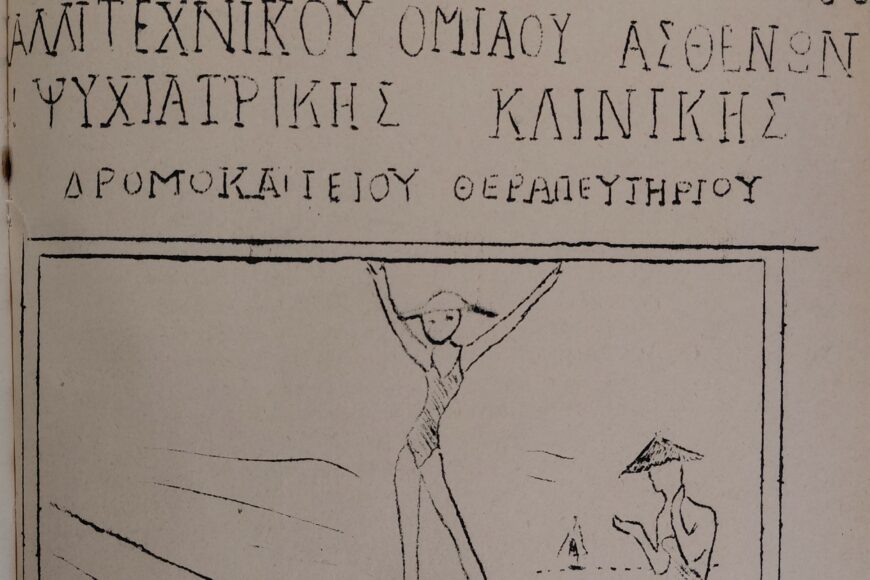
The presented documents originate from the “Monthly Bulletin of the Patients’ Art Club” (Μηνιαίον Δελτίον Καλλιτεχνικού Ομίλου Ασθενών) of the 2nd Psychiatric Clinic at the Dromokaiteio Psychiatric Hospital. This is a periodical publication (with 1961 as the reference year), which was drafted and published by the patients themselves. The publication of monthly bulletins documents a highly engaging effort to integrate art, music, and group entertainment within the framework of psychiatric care in a Greek institution of the era.
As indicated by the editorial of the drafting committee, the Patients’ Art Club, within its very first year of operation, demonstrated an impressive and multifaceted activity, which is rightfully characterized as a “pioneering effort.” The patients’ initiative encompassed a broad spectrum of arts and entertainment. The Club, as is known from its institutional history, managed to establish and coordinate:
- Theatrical performances and Shadow Theater.
- A choir, as well as specialized Music and Dance departments.
- Departments for Entertainment, Excursions, Lectures, and Dinner Dances.
- The operation of a Library.
- The organization of receptions in “Athenian residences” and seaside venues, a fact that denotes a strong effort towards outreach and social reintegration.
- Regular film screenings of “select” Greek and foreign productions. As mentioned on another page of the bulletin, these screenings were held at the institution’s open-air theater twice a week (Wednesdays and Fridays) for an audience of 300 to 400 patients.
The cover of this specific monthly Bulletin is adorned with a handmade, thematic sketch with a strong summer character. Framing the hand-drawn title of the bulletin, the illustration depicts bathers in a seaside landscape: one figure is swimming, while two others, wearing swimsuits and hats, are relaxing by the water. This visual element, beyond its seasonal alignment with the month of August, constitutes a direct reflection of the Club’s activities (such as the aforementioned excursions to seaside venues) and underlines the institutionalized patients’ need for creative expression.
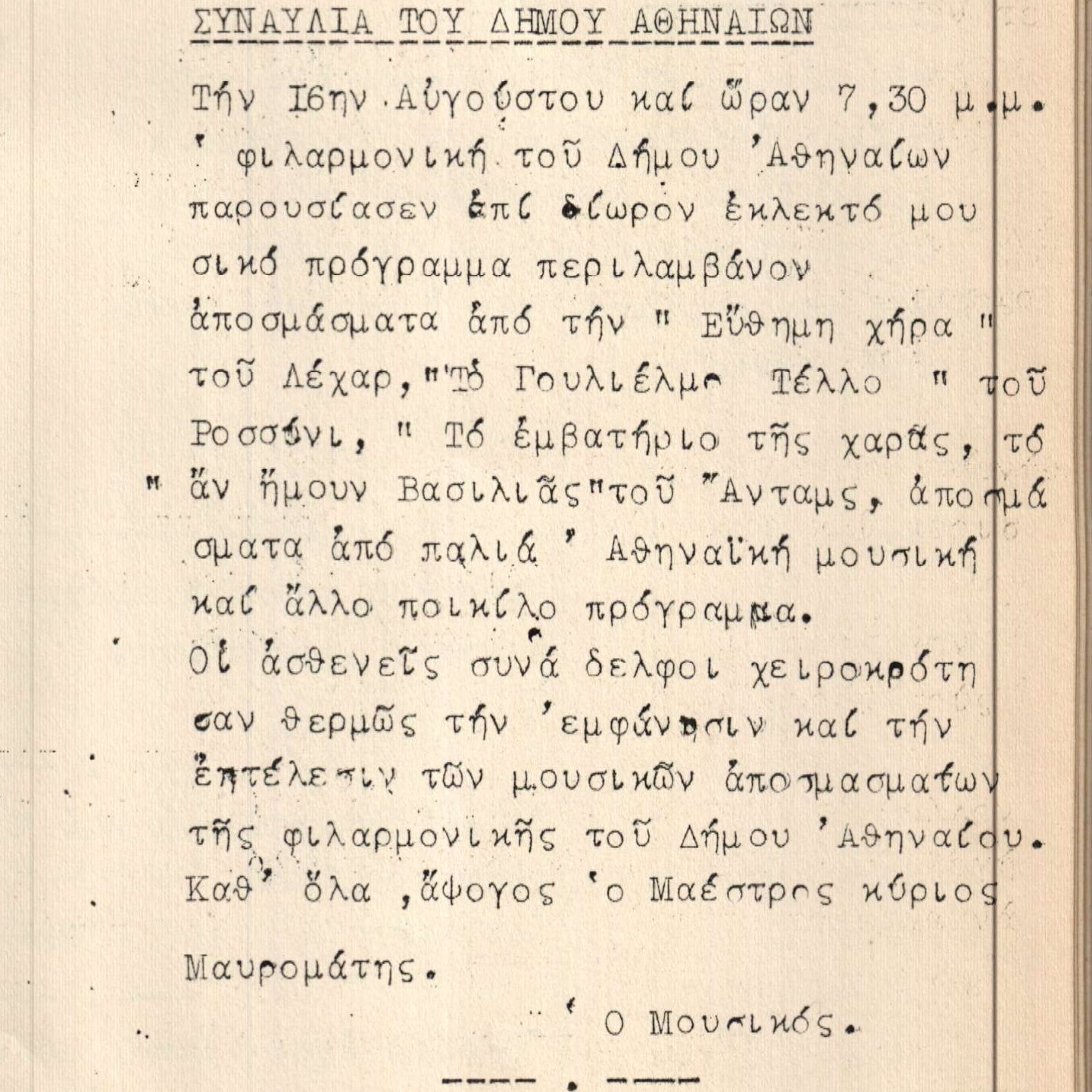
The most notable finding for researchers of institutional and local history is the detailed report on the visit of the City of Athens Philharmonic Orchestra to the psychiatric hospital. This event highlights the interaction between the capital’s municipal institutions and healthcare facilities during the early 1960s.
According to the report, which is signed by a patient using the pseudonym “The Musician” (O Mousikos), on August 16, 1961, at 19:30, the Philharmonic offered the patients a “two-hour select musical program.” Under the flawless direction of Conductor Mr. Mavromatis, the repertoire included the following:
- Excerpts from the operetta The Merry Widow by Franz Lehár.
- Excerpts from William Tell by Gioachino Rossini.
- The work If I Were King (Si j’étais roi) by Adolphe Adam (recorded in the text as “Adams”).
- The “March of Joy” (Emvatirio tis charas).
- Excerpts from old Athenian music and a varied additional program.
The record concludes with the note that the “patient colleagues warmly applauded the appearance,” demonstrating a positive reception.
The entirety of the Bulletin, through both the description of the Patients’ Art Club’s activities and the reception of the City of Athens Philharmonic Orchestra, offers a rare, primary account from the perspective of the recipients themselves. It evidences the active participation of the City of Athens’ cultural structures in social welfare, while simultaneously illuminating unknown aspects of social history and psychiatric care practices in post-Civil War Athens.